
COFAIR COMMUNITY BRIEF
Mitigating the Environmental Noise Impacts of Data Center Expansion
Intended Audience
- Municipal Legislators and Administrators
- Local Executors and City/County Zoning Officials
- Community Leaders and Concerned Citizens
- Data Center Developers and Operators
- Environmental Advocates and Advisors
- Press and Media Outlets
Executive Summary
The unprecedented acceleration of artificial intelligence—predicated on the “Scaling Laws” of computing power—has triggered a global industrial infrastructure build-out. With AI infrastructure investment projected to exceed $1 trillion by 2029, local jurisdictions find themselves at the front lines of a technical and social conflict.
Environmental noise, specifically the continuous low-frequency emissions of high-density cooling and power systems, represents the primary threat to the “social license” of tech operators. This brief outlines a rigorous regulatory framework designed to balance technological growth with community health.
Top 5 Noise Policy Directives
- Mandate multi-weighted acoustic baselines – Require pre-construction studies documenting dBA, dBC, and dBZ levels to ensure full-spectrum frequency accountability.
- Enforce categorical zoning buffers – Utilize land-use classifications (Class 1–5) to mandate specific setbacks (500-foot minimum) and high-density landscaping (for example, 2.4 points per linear foot for residential adjacencies).
- Require high-barrier financial commitments – Implement a $100,000 interconnection study fee and mandatory disclosure of duplicative requests to filter speculative development and prevent grid distortion.
- Codify structural sound attenuation – Mandate masonry enclosures for ground-mounted equipment and integrated sound-attenuating technology for rooftop units behind parapet walls.
- Establish tiered compliance penalties – Shift all third-party auditing costs to the operator and enforce a $10,000 civil penalty per violation until noise abatement is verified.
Introduction and Motivation
The Scale of the Sound Challenge
The regulation of environmental noise is necessary when considering data center construction or expansion. The World Health Organization (WHO) Environmental Noise Guidelines for the European Region (2018) concludes that long-term exposure to environmental noise can cause annoyance, sleep disturbance, and cardiovascular and metabolic disease. The same report brings special attention to the detrimental effects of noise pollution caused by stationary heating, ventilation, and air conditioning (HVAC) equipment, and continuous exposure through day and night, preventing recovery.
| Filter | What it does | Purpose |
|---|---|---|
| dBA | Measures noise perceivable by the human ear by attenuating (de-emphasizing) very low and high frequency sounds. | dBA is the primary baseline for general noise. |
| dBC | Measures peak sounds and low-frequency sounds by reducing attenuation at low frequencies. Replicates human hearing response to high-volume environments. | dBC is helpful for measuring low-frequency sounds, like HVAC machinery, generators, transportation, and bass-heavy music. |
| dBZ | Zero-weighted acoustic pressure levels. Has no attenuation. | dBZ allows for full tonal analysis, without filtering out sounds in any frequency range. Useful for measuring low and high frequency sounds that would be filtered out by dBA filters. |
Data centers operate 24/7, with stationary HVAC equipment, creating noise pollution that has been highlighted by the WHO to be particularly harmful to those who live close by. To ensure that data centers and communities can co-exist harmoniously, municipal leaders and developers must take steps to ensure that agreements on noise mitigation are made, in consultation with residents and community groups, before data center construction to prevent negative health effects for residents.
Anatomy of Data Center Sources of Noise

|
Continuous 24/7 Cooling Infrastructure (70–90 dBA) Cooling tower fans, CRAC/CRAH units, and chiller condensers run continuously, generating broadband noise and low-frequency blade-pass tones (~250 Hz) that scale with the fifth power of fan rotational speed. |
|---|---|
|
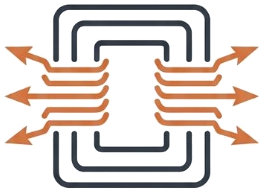
Transformer Core Magnetostriction (120 Hz Hum) Electrical transformers physically vibrate at twice the grid line frequency (120 Hz plus 240 Hz, 300 Hz, and 400 Hz harmonics), producing a pure, unyielding tone that stays constant regardless of whether IT load is at 10% or 100%. |
|
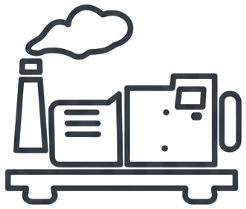
Multi-Megawatt Backup Generators (85–115 dBA) Backup diesel generator sets are the single loudest on-site source; monthly load testing and emergency grid power runs produce intense low-frequency exhaust pulsation audible up to 1 mile (4,000–5,000 feet) away. |
|
Off-Grid Baseload Gas Turbines Facilities utilizing dedicated behind-the-meter natural gas turbines for direct power emit continuous jet-engine-like combustion noise and up to 70 dBA from cooling towers within 400 feet. |
Foundations
Acoustic Measurement for Policy Makers
Environmental noise analysis is usually done by filtering raw data from a microphone through an A-weighted filter to capture noise that is most noticeable to human ears. A-weighted filters attenuate (de-emphasize) high and low-frequency sounds that are less noticeable to human ears, but data centers are known to emit significant low-frequency noises. When conducting acoustic measurements around data centers and industrial sites, it is encouraged to conduct a full tonal analysis, allowing low-frequency sounds, often filtered out by A-weighted measurements, to be fully understood.
- Low-Frequency Noise from data center sources
- A-Weighting (dBA) Filter Curve
The Acoustic Metric Gap
The Flaw of Weighting dBA
Standard dBA filters mimic human hearing in quiet environments by discounting low frequencies—subtracting ~26 dB at 63 Hz and −16.4 dB at 120 Hz—precisely where data center chillers, fans, and transformers concentrate sound. These measurements must be integrated into rigorous land-use standards to ensure that facilities are evaluated against the specific sensitivities of their surrounding environment.
Applicable Methods
Mandating Environmental Noise Mitigation
There are two main approaches to ensure that environmental noise from data centers does not become a public health risk. Many local zoning laws require specific noise mitigation measures, such as setbacks, landscape buffers, and structural mandates, for a variety of land uses, which are easy to enforce throughout the construction process, from the planning stage into operational use.
A different approach, which COFAIR recommends, is to establish property-line noise maximums, which allow developers more flexibility in what technologies they use to mitigate environmental noise, but require more complicated, and expensive, monitoring, which can fall onto neighbors, if a monitoring scheme is not established.
Agreements and regulations on environmental noise should always consider abutting land use, and take special care to protect residential neighborhoods from excessive environmental noise that causes detrimental health impacts.
Specific noise mitigation measures usually are either spatial and structural mitigation or operational constraints, including acoustical barriers, walls higher than any equipment, and having all equipment enclosed.
Operational constraints mainly regard the use of emergency generators. The EPA caps the use of emergency generators to a maximum of 50 hours per year for non-emergency use and testing, but local governments can put stricter guidelines in place, such as allowable times for testing emergency generators. The UK only allows emergency generators to be tested from 8am to 5pm on weekdays (ISEE).
When setting outright noise maximums, communities can choose to limit data centers either with absolute maximums, in line with public health research and resident desire, or in comparison to pre-construction noise levels. Absolute maximums may be preferable in areas with already unacceptably high levels of environmental noise, or areas with a long pipeline of data center construction projects, as each new construction will push up the baseline until noise reaches unacceptable levels.
Noise caps relative to pre-construction levels may be preferable in areas with few industrial construction projects and quiet areas, where new industrial noise may be jarring to residents.
Municipal leaders can choose between methods, or combine them; for example, saying that noise levels must be within 5 dBA of pre-construction sound levels during the day and 3 dBA at night, or under 55 dBA during the day and under 45 dBA at night, when abutting residential areas. When measurements are taken through a dBA filter, governments are encouraged to apply an adjustment to A-weighted dB measurements, such as 5 dBA (as used by the UK and EU), when low-frequency tones dominate the noise signature (BS 4142 / ISO 1996).
Compliance
Mechanisms and Financial Enforcement
Data centers should not be allowed to be constructed with by-right zoning. To ensure that data center construction and expansion is symbiotic with the community, communities should require public hearings before discretionary permits are granted for data center activity. Discretionary permits can take various forms, such as conditional use permits, special use permits, special exceptions, or use permits. These permits should require consideration for environmental noise, and all other locally important issues, such as energy sourcing and use, stormwater runoff, air pollution, heat management, emergency management, and siting.
Public disclosure and hearings are essential, as they allow concerned neighbors to raise issues relevant to them that municipal officials and developers have not addressed, and they allow community leaders time to form a coalition to demand that their voices be heard — either by directly creating a community benefits agreement (CBA) with developers, or by advocating that their government representatives address important issues.
The Noise Compliance Lifecycle
2. Technical Review
Documentation of any and all relevant independent studies, including those on environmental noise, should be handed to relevant authorities for review and made available online before public hearings on discretionary permits.
4. Audit and Penalty
Receipt of a noise complaint triggers a third-party audit at the operator’s expense, verified by an independent acoustic analyst retained by relevant authorities. Violations of a noise ordinance, captured by fence-line monitoring or a third-party audit, trigger substantial civil penalties, assessed daily until the facility is proved to be within limits.
1. Pre-Construction Disclosure
Developers should make their intentions to build a data center clear to the local community through disclosures. A third-party licensed acoustic engineer must establish baseline dBA, dBC, and dBZ levels at all property lines, including a narrow-band tonal analysis, and a full study on environmental noise (compliant with ISO 9613-2) should be completed before public hearings for approval of data center construction or expansion.
3. Post-Construction Verification
Before a certificate of occupancy is issued, the facility must prove that normal operations do not exceed permitted environmental noise levels, and install fence-line noise monitoring systems if within 1,000 feet of sensitive land uses.
5. Curtailment and Facility De-Certification
If operators are unable or unwilling to bring environmental noise within established limits, municipalities order the curtailment of equipment creating out-of-compliance conditions, identified in noise audits. If the facility remains out of compliance, municipalities should start a timely, transparent, and fair process to de-certify the facility for occupancy.
To ensure compliance with environmental noise obligations, data centers should be required to conduct continuous fenceline noise monitoring when near sensitive land uses, such as residential, educational, medical, and recreational uses. The Sierra Club recommends that noise monitoring be conducted with A-weighted and C-weighted measurements, as well as one-third octave narrow band analysis, or equivalent. Noise monitoring should be conducted by certified engineers. They further recommend that data is retained, in public, for 5 years.
Noise monitoring with Class 2, IEC 61672-1 compliant microphones is mandatory in New York City during construction, demonstrating that fence-line noise monitoring is feasible for developers. COFAIR recommends that noise monitoring be established for construction and operational (post-construction) monitoring, though COFAIR recommends different noise ordinances for construction and operational use.
To ensure community trust, noise monitoring results should be published online, either by municipalities or by the developers and operators themselves. Government hosting of noise data allows for easier verification by the government, and will frequently be easier for community members to access. Company publication of noise control data decreases infrastructure costs and complexity for governments, and companies may utilize more user-friendly websites. When governments have strong IT expertise, open data policies, and portals, it is recommended that governments host the data themselves.
With or without fenceline monitoring, credible complaints from community members should be taken seriously, triggering an environmental noise audit, with results published publicly. Environmental noise audits should be conducted by a certified member of the Institute of Noise Control Engineering (INCE) or a licensed professional engineer. Municipalities should retain their own acoustic consultant — funded by developers through CBAs, escrow established in discretionary zoning agreements, or irrevocable letters of credit — to verify the accuracy of the audit.
CBAs or discretionary permitting should be used by relevant parties to create substantial financial penalties for non-compliance with agreed-upon noise limits. Existing noise-ordinance fines are often deficient for data center operators. For example, Prince William County in Virginia caps fines at $5,000 for repeated noise control ordinance violations, which is a pittance compared to the potential revenue generated by hyperscale data centers. Some communities are demanding up to $50,000 per day for willful non-compliance with environmental ordinances, like noise ordinances (SciLine).
Agreements and zoning laws should maintain the ability to levy substantial financial penalties against operators, but fines can prove inadequate in the face of the deluge of capital investment in data centers. If operators are unable or unwilling to comply with their obligations, even in the face of fines, there should exist a fair and transparent method for offending equipment to be curtailed, and for the entire data center to be de-certified for occupancy.
Noise Mitigation Solutions
There are various technologies and operational techniques that can be utilized to mitigate environmental noise at large-scale data centers. Governments, or community groups through CBAs, can mandate their employment, or communities can create noise caps, allowing developers and operators to decide what strategies to use.
Equipment Noise Signatures at Source
| Equipment / Source | Typical Level at Source | Dominant Frequency Content | Physical Origin | Duty Cycle |
|---|---|---|---|---|
| Cooling Tower / CRAC Fans | 70–85 dBA at 20 ft | Broadband + blade-pass tones (<250 Hz) | Blade-pass frequency = (blade count × RPM) / 60 | Continuous (24/7) |
| Chillers / Compressors | 75–95 dBA at source | Broadband + compressor tone | Reciprocating / scroll / screw cycling | Continuous (load-following) |
| Transformers / Switchgear | 40–65 dBA at source | Pure 120 Hz tone + harmonics (240, 360, 480 Hz) | Magnetostriction of the core | Continuous (independent of load) |
| Backup Diesel Generators | 85–115 dBA at source | Broadband engine + exhaust tones (low-frequency) | Engine firing frequency, exhaust pulsation | Intermittent (testing / outages) |
Site-design mitigation techniques are most familiar to municipal governments, as site design is frequently regulated by zoning, across industries:
- Setbacks – mitigate noise by allowing noise to dissipate in space and be absorbed by air molecules. Setbacks are most effective at mitigating short-wavelength (high-frequency) sounds, and have significant impacts on what proportion of the site can be used for equipment.
- Mass-loaded Vinyl and Acoustic Blankets – Mass-loaded vinyl can be placed into walls during construction, or attached to either side of the wall after construction, creating significantly more acoustical dampening from the structures themselves. Acoustical blankets provide a similar function, but are normally only placed inside a building.
- Indoor Accessory Equipment – Placing accessory equipment, like generators, inside enclosed buildings.
- Parapet Walls or Acoustic Louvers for Exposed Equipment – Data centers frequently have accessory equipment on their roofs and power-generation equipment outside the main data center buildings. These should all be enclosed by parapet walls, or acoustic louvers when airflow is necessary. Acoustic barriers placed closer to equipment are more effective at noise mitigation, but create more airflow disturbances, causing efficiency declines in equipment that requires constant airflow.
- Internal Standing-Wave Absorption – Acoustic panels can be placed around enclosures housing equipment that creates low-frequency tones, to break up standing-wave patterns and mitigate low-frequency tones.
- Earthen Berms and Landscaping Barriers – Earthen berms (mounds of dirt) can create an economical and significant sound-deadening effect, but they require lots of space. They can be adorned with landscaping buffers primarily for aesthetic purposes. While landscaping can theoretically act as a noise buffer, effects are limited and seasonally inconsistent (Sierra Club).
- Green Roofs – can have an impact on noise emissions, particularly low-frequency noise emissions, but are most effective at reducing noise above the data center site. They are frequently an inefficient way to mitigate noise emissions.
Internal Cooling Systems
Cooling technologies are the dominant source of continuous noise at large-scale data centers, so the choice of cooling technology has a dramatic impact on the noise emissions of a data center.
Liquid & Immersion Cooling Cut Internal Noise Over 50% While Slashing Energy Overhead
Acoustic Profile & Noise Reduction
Resource Draw: Energy Overhead (PUE)
Data centers usually have two interconnected cooling systems: an internal cooling system and an outdoor heat-rejection system. The internal cooling system cools the servers, and the outdoor heat-rejection system dissipates the heat absorbed by the internal cooling system. The systems include:
- Room Air Cooling (CRAC/CRAH) uses air conditioners (CRAC) or air handlers connected to an external cooling plant (CRAH) to cool the entire server room.
- Variable-Speed Drives. Fan acoustic emissions scale exponentially with fan speed, so variable-speed drives, which allow fans to operate at a speed in line with need, can create exponentially less noise.
- Aerodynamic Fan Design. Aerodynamic fan blades, frequently designed with computational fluid dynamics, can reduce the speed that fans need to operate at, reducing noise emissions exponentially.
- Rear-Door Heat Exchangers (RDHx) use liquid cooling on server racks to cool server exhaust air to room temperature as it is emitted from a server rack. RDHx reduces or removes the need for large-scale room cooling.
- Direct-to-Chip (cold plate) Liquid Cooling cools chips directly, with refrigerant circulating within server racks. Direct-to-chip liquid cooling drastically reduces or removes the need for air circulation in server rooms.
- Immersion Cooling immerses server racks in a thermally conductive and electrically insulating liquid to cool servers and chips, without damaging them.
External Heat-Rejection Systems
- Evaporative Chillers are the cheapest technology for heat rejection, evaporating significant amounts of water to cool thermal systems. They are very loud.
- Air-Cooled Dry Chillers use fans to reject heat, without relying on water evaporation to boost efficiency. They create similar noise emissions to evaporative chillers, using less water and more energy.
- Hybrid / Adiabatic Chillers – usually operate as dry chillers, utilizing water to boost efficiency in the hottest moments. They have a similar noise signature to dry and evaporative chillers, using less water than evaporative chillers and less energy than dry chillers.
- Free Cooling / Economization – utilizes filtered cold air from outside, instead of a heat-rejection system. It is not appropriate in every setting, and is frequently seasonal.
- District heating, particularly 4th-generation district heating (4GDH) – Refrigerant from direct-to-chip and immersion cooling systems is exhausted from data centers. Cold-plate and immersion cooling systems create hot liquid in the range desired for 4GDH networks (50–70°C) that can be exchanged into a district heating system using almost no moving parts, meaning heat rejection is nearly silent during heating months. Data centers in Europe are mandated to utilize waste heat productively, and many are already connected to district heating systems.
District Heat Export & Dry Coolers Eliminate Millions of Gallons of Water Draw & 24/7 Noise
Resource Draw: Water Consumption Rate
Acoustic Profile: Outdoor 24/7 Noise Emission
Power Supply and Generation
Power generation causes the most acute sound emissions, though unless a data center has behind-the-meter generation, emissions from generators are limited to emergency use. Transformers produce considerable, consistent, low-frequency humming.
- Minimizing combustion-based generation – Nearly all data centers utilize emergency generation and an uninterruptible power supply (UPS) to ensure continuous operations through grid disruptions. Natural gas generators are commonly used for behind-the-meter power generation, and natural gas and diesel turbines are frequently used for emergency generation, causing notable spikes in noise emissions. Data centers that utilize batteries and clean energy generation, such as solar, can minimize the use of emergency generation and associated emissions.
- Transformer vibration isolation and active noise cancellation – Transformers produce steady low-frequency noise that can pass through noise-mitigation treatments installed by developers. Dedicated vibration isolators stop sound vibrations at the source. Because transformer vibration is highly predictable — it follows the alternating current in the power supply — active noise cancellation also shows promise.
- Generator and turbine silencers – Diesel generators and natural gas turbines can be fitted with silencers of various grades to reduce noise emissions, but they can have performance implications (making the generators less efficient), are more effective at stopping high-frequency sounds than low-frequency sounds, and turbines frequently need a bypass stack (bypassing silencers) during startup and shutdown. An industrial noise-control manufacturer, Hushtec, claims that silencers can reduce emissions by up to 25 dB in A-weighted decibels (more sensitive to high-frequency sounds). In C-weighted decibels, which are more attentive to low-frequency hums, the effect would be smaller.